About two years ago, when there was already information about a possible invasion of Ukraine by the Russian army, I wrote a post in this blog relating those winds of war with patents. In that post I expressed my surprise at the fact that, despite being in a war situation, since the annexation of Crimea by the Russian Federation in 2014, although not an all-out war like the current one, nevertheless, patents on weapons were published in both states. Those publications took place despite the fact that both the Russian Federation and Ukraine have in their legislations rules that allow imposing secrecy orders on those inventions of interest for national defence.
I recently had the opportunity to read an article with the title “The war in Ukraine Raises Questions About Patents for Secret Inventions” by Duncan Matthews and Hanna Ostapenko, GRUR International, Volume 72, Issue 7, July 2023, Pages 665-669.
The article seems to suggest between the lines that the Ukrainian state has increased the number of patent applications that are kept under secrecy and warns Ukraine of the long-term negative implications for future innovation.
The literature mentions two situations in which the number of “secret” patent applications tends to increase:
The first of these, in which the information on Ukraine would fall, is a war environment. A well-studied case is what happened in the United States during the Second World War. A reference article is “The hidden costs of securing innovation: the manifoled impacts of compulsory invention secrecy” by Daniel P. Gross – Working Paper 25545 – National Bureau of Economic Research.
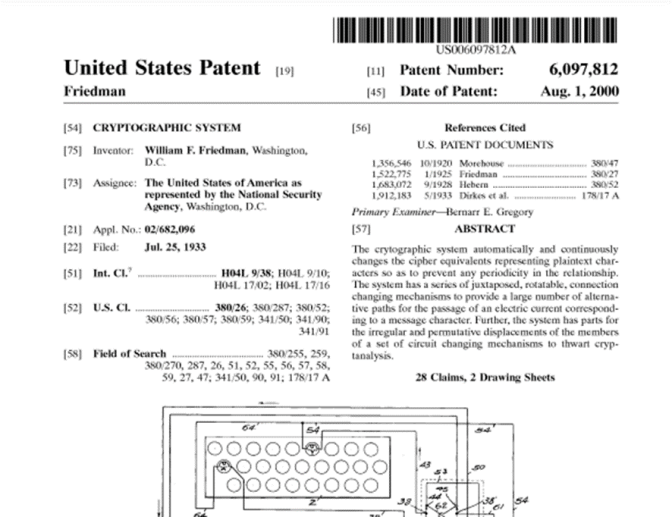
This article studies the consequences of the massive imposition of secrecy on patent applications in the United States during World War II. This was a unique moment in the history of the Patent System; during the period 1941-1945 secrecy was imposed on more than 11,000 patents and patent applications pertaining to diverse sectors such as radar, cryptography or synthetic materials. Most of these secrecy orders were lifted at the end of the war. This exceptional situation provides an opportunity to study the effects of compulsory secrecy on innovation. The conclusion of the study is that compulsory secrecy in patents in order to prevent domestic technology from leaking to foreign competitors deters companies from inventing or launching new products in the affected areas, hindering the innovation that would result from these unpublished patents.
Another situation in which historically a large number of patent applications have been kept secret is that in which certain states, usually dictatorships, have had a tendency to isolationism. The article “Secrecy in the USSR and German Democratic Republic Patent Systems” Martens, J.A. (2021) is particularly interesting in this respect. Thanks to that article we know that, during the Cold War period, after World War II and until the demise of both states, the percentage of patents and patent applications that were kept secret (10-20%) was much higher than usual percentage in Western democratic states (0.1-0.6%). The reasons for this higher percentage of secrecy are clearly explained in a quote from the book “Geheimhaltung und schutzrechtliche Sicherung von Ergebnissen der wissenschaftlich-technischen Arbeit” (Confidentiality and protection of the results of scientific and technical work under intellectual property law) by Wiedemann, Arno and Jürgen Zobel (1975):
“Secrecy serves to deny the adversary access to scientific and technical results. Maintaining secrecy is a proper means to secure an achieved technological advantage over capitalist competitors in order to surprise the adversaries in markets and eliminate them as competitors. Furthermore, the capitalist businesses should be given no possibility to enrich themselves at the expense of the work of GDR employees by appropriating their scientific technical achievements”
This quote also explains why secrecy was not used as an alternative to imposing secrecy on patents; that way it was possible to enforce the secret patents in the event of an attempt to commercialize such foreign technology in the state.
Contrary to what one might think, countries with a democratic system have considered whether to extend secrecy to non-defence patent applications.
In 2012, the U.S. Congress asked the U.S. Patent and Trademark Office (USPTO) to examine whether it was feasible to impose secrecy also on those inventions that were economically significant and the USPTO issued a request to the public for comments.
These were the questions posed:

The comments were very negative and the proposal was not successful. IBM, for example, stated that the applicant is in the best position to decide whether to protect his invention by patent or by keeping it secret and that neither the USTO nor any other US government agency has the expertise to determine whether the economic value of an invention requires it to be kept secret.
Conclusions
Within the social contract that the patent system represents, it is essential that inventions protected by patents are published so that Society benefits from the disclosure of the invention, which must comply with the requirement of sufficiency of the description. The only justified exception is for those inventions whose publication would be detrimental to national defence or security.
In this regard, I am concerned about what appears to be a growing use of trade secrets, largely because software-based innovation, including AI, lends itself to this form of protection more than innovations in more traditional technologies.
Of course, it is legitimate to opt for secrecy for the protection of intangibles, even if this entails risks. It is often said that, if it can be kept secret, it is advisable not to disclose it and the example of the secret formula for Coca-Cola is often cited. Secrecy can be maintained indefinitely, while patents have an expiration date. However, what I see as most negative is the promotion of this modality from various Organizations. The lack of publication of inventions has negative consequences on the innovation system, as shown by what happened in the United States during World War II.
Leopoldo Belda Soriano

 Examen Sustantivo
One thought on “SECRECY IN INVENTIONS AND ITS REPERCUSSIONS ON THE INNOVATION SYSTEM”