October 5, 2023 marked the 50th anniversary of the signing in Munich, by 16 European states, of the European Patent Convention, also known as the Munich Convention on the Grant of European Patents. One day after that October 5, 1973, the Yom Kippur War began, in which Egypt and Syria attacked Israel, triggering a deep energy crisis in the West. The previous month the Federal Republic of Germany and the German Democratic Republic had been admitted to the United Nations, and in Chile the government of Salvador Allende had been violently overthrown. Spain was in the final years of Franco’s dictatorship and two months before the assassination of Carrero Blanco. Fifty years later, another war, this time in Europe, has also caused an energy crisis; on the other hand, Germany has been unified for almost 35 years and is the main European power; there is a new war in which Israel is involved, while Chile and Spain are already two consolidated democracies.
The Convention was the fruit of 20 years of negotiations and its major precursors include the Paris Union Convention (1883), the PCT (Patent Cooperation Treaty) (1970, although it entered into force in 1978) and the International Patent Institute (IIB- Institut International des Brevets-1947), which later became the European Patent Office.
The goal of the Convention was to streamline the patent application and granting procedure in Europe, going far beyond the PCT by regulating a centralized patent granting procedure and harmonizing the patent laws of the member states.
More than 50 years have passed since it was signed and it can be said that the European Patent Convention has been a resounding success, with 39 member states, one extension and four validation states, three of which are not European.
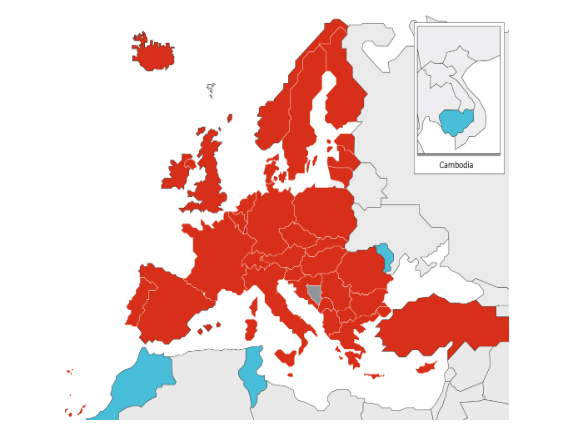
Red: Member States
Gray: Extension States
Blue: Validation states
Source: EPO
Within the European Patent Organization defined in the Convention, the European Patent Office, which was opened in 1977 in Munich located in a rented building (the “Motorama Building”) and 98 employees, plays an essential role. The first patent application EP0000001A1 was filed on June 1st, 1978, and its subject matter was a heat pump.

First European Patent Application
Its predecessor, the IIB (Institut International des Brevets) was based in The Hague and had been founded in 1947 to carry out patent searches for Belgium, France, Luxembourg and the Netherlands. Subsequently, the IIB was joined by Turkey (1955), Monaco (1956), Switzerland (1960), the United Kingdom (1965) and Italy (1974). In 1978 it became part of the European Patent Office and its headquarters in The Hague took over patent searches and the handling of all the necessary documentation. Also that year, a third office was opened in Berlin, in the building that had housed the Imperial German Patent Office, which was in charge of searches.
The first president of the European Patent Organization was Johannes Bob Van Benthem, formerly president of the Netherlands Patent Office, and he held the post until 1985.
In 1980, the so-called “Isar Building”, the headquarters of the Office’s management, was opened in Munich. That year, 20,000 patent applications had already been filed. Italy and Sweden had joined the Convention in 1978, Liechtenstein in 1980 and the first European patent was granted in January.

ISAR building (Headquarters of the European Patent Office in Munich) (Source: European Patent Office)
Spain acceded to the European Patent Convention on July 10th, 1986 following its accession to the European Economic Community on January 1st of the same year, although the signature had taken place in Madrid in June 1985. Accession to the Convention completely modified the Spanish patent system.
Prior to the entry into the European Economic Community in 1986, the obsolete Industrial Property Statute of 1929 was in force in Spain, which regulated a patent granting procedure of simple deposit (only the formal requirements were examined) that did not even define or required the requisite of inventive step, and contemplated such peculiar figures as patents of introduction and “protection” or defensive patents.
In order to join the European Economic Community in 1986, Spain had to make great efforts and harmonize its legislation in numerous fields. One of them was patents. It was necessary to pass patent legislation, the Law 11/1986, which was in line with the European Patent Convention and was suitable for promoting Spain’s technological development. Introductory patents were abolished and the patentability of chemical, pharmaceutical and food products was introduced, although the latter did not come into force until October 7th, 1992.
The granting of this reservation with respect to the patentability of chemical and pharmaceutical products was approved at the Administrative Council of the European Patent Office in January 1986. Also in said Council, it was agreed by qualified majority that Spain would request to act, in due course, as International Searching Authority (PCT), which became a reality in 1993.
Likewise, a patent granting procedure with search report and substantive examination was regulated, although it was established that given the modifications that needed to be introduced in the then Industrial Property Registry in order to be able to deal with such tasks, this would be done progressively. The first search reports or IET’s (Reports on the State of the Art) were drafted in 1990 on applications relating to the field of agriculture and food and the first substantive examinations was carried out in the food sector in the year 2000.
It was not at all easy to move from a patent office with a simple deposit granting procedure to a patent office like the present one where prior art searches and substantive examinations are carried out.
The main obstacle was the lack of personnel with the technical/scientific, legal and language skills necessary to conduct patent searches and examinations.
Therefore, on May 8th, 1984 a first call for scholarships for the training of patent examiners was published in the BOE, a second call for traineeships on April 13th, 1985 and a third call for traineeships on January 29th, 1987. The scholarships had a duration of 8 months, a monthly endowment of 60.000 pesetas (360 €) and a daily allowance of 6.000 pesetas (36 €) for stays abroad, since a training period at the European Patent Office was contemplated. Subsequently, competitive examinations (“oposiciones”) were held and a very important part of the traineeship holders became civil servants. Some of these first civil servants still work at the SPTO.
In addition to hiring qualified patent examiners, the SPTO acquired the necessary documentation to carry out patent searches and progressively incorporated electronic means and it has recently incorporated AI technology, thus making it possible to carry out a complete search of the state of the art.
The incorporation to the European Patent Convention, made it possible for Spain to count in record time and starting from a simple deposit Office, with a Patent Office capable of performing searches and examination of patentability. A Patent Office that managed to join the elite club of those known as International Search and Examination Authorities of the PCT (Patent Cooperation Treaty – Patent Cooperation Treaty).
Spain’s accession to the European Patent Convention was also reflected in the statistics. The main impact was seen in the number of national patent applications filed with the Industrial Property Registry (currently the SPTO/OEPM). As can be seen in the following graph, if in 1985 around 11,000 national patent applications had been filed with the Industrial Property Registry, in 1987 and 1988 the number had dropped to just over 4,000 national patent applications and subsequently stabilized at a number ranging between 3,000 and 3,500. Years later, with the entry into force of the Law 24/2015 there was a further drop in the number of national patent applications, and 1,231 national patent applications were filed in 2022.
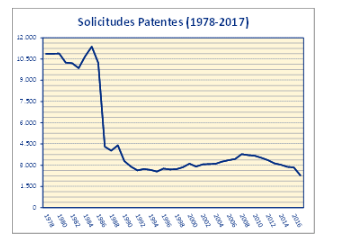
What happened was that a very significant percentage of applicants, mainly foreigners, stopped using the “national route” and began to validate in Spain the patents granted by the European Patent Office, so that at the beginning of the 1990s around 13,000 European patents were validated annually in Spain and currently approximately 30% of all European patents granted are validated in Spain. In total, the number of patents in force in Spain increased as a result of joining the European Patent Convention.

In 1987, a small group of Spanish patent examiners began working at the European Patent Office, followed the next year by a larger group that also included other professionals destined to occupy different positions in the Organization. In 1987 there were already several Spanish employees at the European Patent Office: a chief administrator of the computer services, a member of the appeal chamber, a head of the international cooperation section and fifteen patent examiners.
Throughout these years, the Spanish workforce has increased steadily to 490 Spaniards today, representing 7.8% of the total number of employees.
The presence of Spaniards in the European Patent Office has not been limited only to technical and administrative levels, but also some Spaniards have held different management positions and occupied 2 Vice-Presidencies: Manuel Desantes (2001-2008) was Vice-President in DG5 (Legal and International Affairs) and Alberto Casado (2012-2018) Vice-President for Operational Support and in a second phase Vice-President of DG1 (Patent Grant Procedure).
Once part of the European Patent Organization, Spain began to participate very actively within the European Economic Community (EEC) in all aspects concerning industrial property, for example, in the negotiations on the Community patent of the Luxembourg Convention, where changes in the language regime were already being advocated. Also in 1987, the Spanish Government offered Madrid as the seat of the future Community Trademark Office, and it was one of the four cities chosen by the Commission in a first pre-selection.
Spanish companies have been undergoing a continuous process of internationalization over the years, becoming increasingly aware of the importance of protecting their innovations abroad. As a result there has been a constant increase in the number of applications for European patents of Spanish origin, which has risen from 102 in 1986 to some 2,000 in 2022, with Spain occupying 17th place among the 50 largest applicants for European patents.

Although Spain’s membership of the European Patent Convention can be described as a success story, there has remained a bittersweet taste; the Spanish language is not an official language and this has always put our applicants on an unequal situation with those who can use their mother tongue in the granting procedure applied by the European Patent Office. Spain never gave in on language issues and therefore did not ratify the London Agreement (2000) by which the signatory states reduce the translation requirements for the validation of European patents. In Spain, the translation into Spanish of the complete specification of the European patent is required for its validation.
Although the first draft of the unitary patent, known as the Community Patent Convention of Luxembourg (1975) established in its Article 33 that after the grant of the patent the claims would be translated into the official languages of the contracting states whose official languages were not those of the European Office, then Danish, Dutch and Italian, this was not preserved in the European patent with unitary effects that came into force on June 1, 2023 after an enhanced cooperation and without the participation of Spain. Consequently, the marginalization of the Spanish language persists, unlike what happens in the European Union Intellectual Property Office (EUIPO) where Spanish is an official language.
CONCLUSIONS
The incorporation of Spain to the European Patent Convention meant a modernization of the Spanish Patent System triggered by the accession to the EEC, currently the European Union, and parallel to the one that took place in so many other aspects of our country. Today, the European patent is fully consolidated and even the “unitary patent” has recently entered into force. Likewise, the European Patent Office has become a world reference in relation to the search and substantive examination of patents. All this has contributed to the fact that currently all patents granted with effect in Spain have been subjected to a patentability examination and that the SPTO has become a modern, medium-sized Industrial Property Office capable of carrying out complete searches of the state of the art and substantive examinations.
Leopoldo Belda Soriano

 Examen Sustantivo